# The Self and Singleton Class in Ruby
In Ruby, everything is an object, and every object has an anonymous class, which defines the methods the object can respond to. This anonymous class is called the _singleton class_.
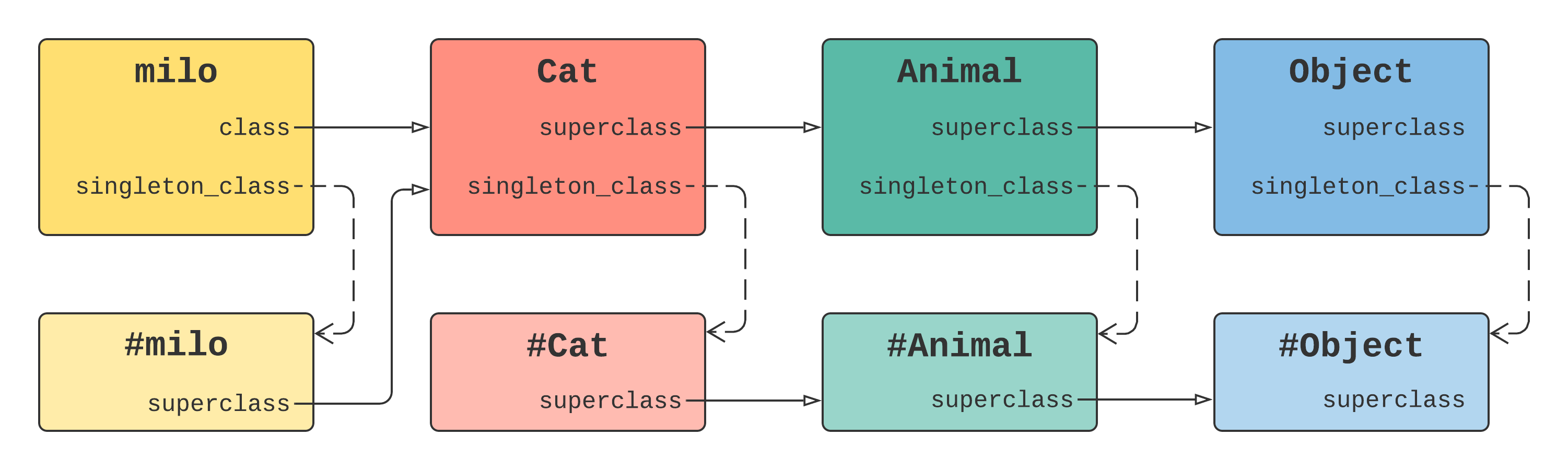 When calling a method on an object, Ruby will perform the method lookup by first checking on the object’s _singleton class_, before traversing the rest of the method chain.
## Ruby has no class methods
The class methods are just instance methods on its _singleton class_.
```ruby
class Animal
def self.all; end
end
Animal.singleton_methods
#=> [:all]
Animal.singleton_class.instance_method(:all)
#=> ##all()>
```
## The "current class"
Ruby always holds a reference to the current class, which is called "[default definee](https://blog.yugui.jp/entry/846)" by Yugui of the Ruby core team. Thus, if you define a method without giving an explicit receiver, the _current class_ will have the method as an instance method.
```ruby
class Animal
def weight; end
end
Animal.instance_method(:weight)
#=> #
```
If you give a receiver to a method definition, the method will be added into the _singleton class_ of the receiver.
```ruby
word = "hello"
def word.spell; end
word.singleton_class.instance_method(:spell)
#=> #>#spell()>
```
The `class` syntax changes both `self` and the _current class_ to the class which is being defined. However, method definition doesn't.
```ruby
class Foobar
def foo
def bar; end
def self.baz; end
end
end
f = Foobar.new
f.foo
Foobar.instance_method(:foo)
#=> #
Foobar.instance_method(:bar)
#=> #
Foobar.singleton_methods
#=> []
f.singleton_methods
#=> [:baz]
```
## The eval methods
In Ruby, `instance_eval` and `class_eval` provide that provide the ability to modify a class or an object. The names are very similar, and their behavior is counterintuitive.
- Use `ClassName#instance_eval` to define a _class method_ (one associated with the class object but not visible to instances).
- Use `ClassName#class_eval` to define an _instance_ method (one that applies to all of the instances of `ClassName`).
To understand why this is true, let’s see what happens when we call the eval methods.
The `instance_eval` changes `self` to the receiver, the _current class_ to its _singleton class_.
```ruby
class Animal
def weight; end
end
Animal.instance_eval do
def all; end
end
Animal.instance_method(:all)
#=> NameError (undefined method `all' for class `Animal')
Animal.singleton_class.instance_method(:all)
#=> ##all()>
```
The `class_eval` changes both `self` and the _current class_ to the receiver.
```ruby
class Animal; end
Animal.class_eval do
def weight; 1 end
end
Animal.instance_method(:weight)
#=> #
Animal.new.weight
#=> 1
Animal.weight
#=> NoMethodError (undefined method `weight' for Animal:Class)
```
## Open classes
Ruby supports a concept known as "Open classes", which opens the object's _singleton class_. This is equivalent to giving a receiver a method definition.
```ruby
class Example
class << self
def foo; end
end
def self.bar; end
end
class << Example
def baz; end
end
Example.singleton_methods
#=> [:foo, :bar, :baz]
```
Let's go through some examples:
```ruby
class Foobar; end
Foobar.instance_eval do
self #=> Foobar
def method_by_instance_eval; end
end
Foobar.class_eval do
self #=> Foobar
def method_by_class_eval; end
end
class << Foobar
self #=> #
def method_by_open_class; end
end
Foobar.instance_methods
#=> [:method_by_class_eval, ...]
Foobar.singleton_methods
#=> [:method_by_instance_eval, :method_by_open_class]
```
The above context changes can be summarized in the following table:
| | self | current class |
| ----------------- | :------------------------------ | ------------------------------- |
| class_eval | the receiver | the receiver |
| instance_eval | the receiver | singleton class of the receiver |
| class << receiver | singleton class of the receiver | singleton class of the receiver |
## Takeaways
In Ruby,
1. everything is an object, and every object has a singleton class;
2. there are no class methods;
3. the `instance_eval` changes `self` to the receiver, the _current class_ to its _singleton class_;
4. the `class_eval` changes both `self` and the _current class_ to the receiver;
5. what "open classes" does is opening the singleton class of the receiver object.
## References
- [Understanding Ruby Singleton Classes](https://devalot.com/articles/2008/09/ruby-singleton)
- [What is the Singleton Class in Ruby?](https://maximomussini.com/posts/understanding-the-singleton-class/)
- [Self in Ruby: A Comprehensive Overview](https://airbrake.io/blog/ruby/self-ruby-overview)
- [Metaprogramming in Ruby: It's All About the Self](https://yehudakatz.com/2009/11/15/metaprogramming-in-ruby-its-all-about-the-self/)
- [Three implicit contexts in Ruby](https://blog.yugui.jp/entry/846)
- [Understanding class_eval and instance_eval](https://web.stanford.edu/~ouster/cgi-bin/cs142-winter15/classEval.php)
- [class_eval vs instance_eval - Matheus Moreira](https://stackoverflow.com/a/10306049)
- [Diving into Ruby Singleton Classes](https://medium.com/@leo_hetsch/demystifying-singleton-classes-in-ruby-caf3fa4c9d91)
When calling a method on an object, Ruby will perform the method lookup by first checking on the object’s _singleton class_, before traversing the rest of the method chain.
## Ruby has no class methods
The class methods are just instance methods on its _singleton class_.
```ruby
class Animal
def self.all; end
end
Animal.singleton_methods
#=> [:all]
Animal.singleton_class.instance_method(:all)
#=> ##all()>
```
## The "current class"
Ruby always holds a reference to the current class, which is called "[default definee](https://blog.yugui.jp/entry/846)" by Yugui of the Ruby core team. Thus, if you define a method without giving an explicit receiver, the _current class_ will have the method as an instance method.
```ruby
class Animal
def weight; end
end
Animal.instance_method(:weight)
#=> #
```
If you give a receiver to a method definition, the method will be added into the _singleton class_ of the receiver.
```ruby
word = "hello"
def word.spell; end
word.singleton_class.instance_method(:spell)
#=> #>#spell()>
```
The `class` syntax changes both `self` and the _current class_ to the class which is being defined. However, method definition doesn't.
```ruby
class Foobar
def foo
def bar; end
def self.baz; end
end
end
f = Foobar.new
f.foo
Foobar.instance_method(:foo)
#=> #
Foobar.instance_method(:bar)
#=> #
Foobar.singleton_methods
#=> []
f.singleton_methods
#=> [:baz]
```
## The eval methods
In Ruby, `instance_eval` and `class_eval` provide that provide the ability to modify a class or an object. The names are very similar, and their behavior is counterintuitive.
- Use `ClassName#instance_eval` to define a _class method_ (one associated with the class object but not visible to instances).
- Use `ClassName#class_eval` to define an _instance_ method (one that applies to all of the instances of `ClassName`).
To understand why this is true, let’s see what happens when we call the eval methods.
The `instance_eval` changes `self` to the receiver, the _current class_ to its _singleton class_.
```ruby
class Animal
def weight; end
end
Animal.instance_eval do
def all; end
end
Animal.instance_method(:all)
#=> NameError (undefined method `all' for class `Animal')
Animal.singleton_class.instance_method(:all)
#=> ##all()>
```
The `class_eval` changes both `self` and the _current class_ to the receiver.
```ruby
class Animal; end
Animal.class_eval do
def weight; 1 end
end
Animal.instance_method(:weight)
#=> #
Animal.new.weight
#=> 1
Animal.weight
#=> NoMethodError (undefined method `weight' for Animal:Class)
```
## Open classes
Ruby supports a concept known as "Open classes", which opens the object's _singleton class_. This is equivalent to giving a receiver a method definition.
```ruby
class Example
class << self
def foo; end
end
def self.bar; end
end
class << Example
def baz; end
end
Example.singleton_methods
#=> [:foo, :bar, :baz]
```
Let's go through some examples:
```ruby
class Foobar; end
Foobar.instance_eval do
self #=> Foobar
def method_by_instance_eval; end
end
Foobar.class_eval do
self #=> Foobar
def method_by_class_eval; end
end
class << Foobar
self #=> #
def method_by_open_class; end
end
Foobar.instance_methods
#=> [:method_by_class_eval, ...]
Foobar.singleton_methods
#=> [:method_by_instance_eval, :method_by_open_class]
```
The above context changes can be summarized in the following table:
| | self | current class |
| ----------------- | :------------------------------ | ------------------------------- |
| class_eval | the receiver | the receiver |
| instance_eval | the receiver | singleton class of the receiver |
| class << receiver | singleton class of the receiver | singleton class of the receiver |
## Takeaways
In Ruby,
1. everything is an object, and every object has a singleton class;
2. there are no class methods;
3. the `instance_eval` changes `self` to the receiver, the _current class_ to its _singleton class_;
4. the `class_eval` changes both `self` and the _current class_ to the receiver;
5. what "open classes" does is opening the singleton class of the receiver object.
## References
- [Understanding Ruby Singleton Classes](https://devalot.com/articles/2008/09/ruby-singleton)
- [What is the Singleton Class in Ruby?](https://maximomussini.com/posts/understanding-the-singleton-class/)
- [Self in Ruby: A Comprehensive Overview](https://airbrake.io/blog/ruby/self-ruby-overview)
- [Metaprogramming in Ruby: It's All About the Self](https://yehudakatz.com/2009/11/15/metaprogramming-in-ruby-its-all-about-the-self/)
- [Three implicit contexts in Ruby](https://blog.yugui.jp/entry/846)
- [Understanding class_eval and instance_eval](https://web.stanford.edu/~ouster/cgi-bin/cs142-winter15/classEval.php)
- [class_eval vs instance_eval - Matheus Moreira](https://stackoverflow.com/a/10306049)
- [Diving into Ruby Singleton Classes](https://medium.com/@leo_hetsch/demystifying-singleton-classes-in-ruby-caf3fa4c9d91)